
Understanding Accessibility Needs in Dementia
This research project is funded by Inclusive Information and Communications Technology RERC (90REGE0008) from the National Institute on Disability, Independent Living, and Rehabilitation Research (NIDILRR), Administration for Community Living (ACL), Department of Health and Human Services (HHS). Learn more about the work of the Inclusive ICT RERC.
Project Team: Amanda Lazar (Lead); Emma Dixon, Jesse Anderson, Ruipu Hu (Students); Mary Radnofsky, Diana Blackwelder (Advocates)
Potential impact of this project on the lives of people with disabilities
As the general population ages, more individuals will experience dementia. Our technologies are often designed with neurotypical users in mind, and therefore the impacts of dementia on memory, language skills, visual perception, problem solving, self-management, and the ability to focus can make using information and communication technology challenging.
Because so many aspects of living in our world require the use of technology and digital information, it is important that we understand the accessibility needs of people with dementia. This understanding can contribute to technology design that will allow people with dementia to continue to participate in meaningful and enjoyable activities.
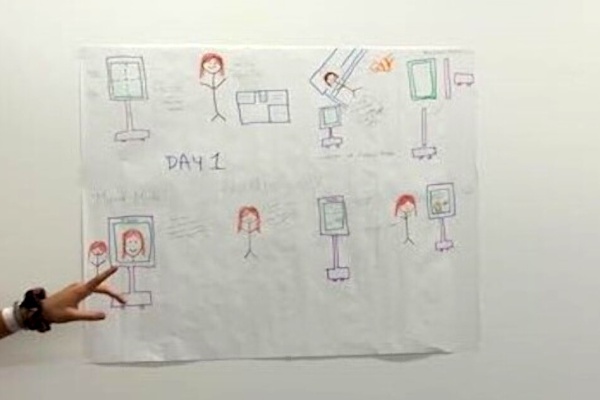
To better understand accessible technology design for people with dementia, we are conducting interviews, observations, and co-design workshops with people at different stages of dementia as well as practitioners who work closely with people with dementia to contribute to knowledge in this area.
This project will help make the following outcomes possible:
- New interface strategies that can make technologies more accessible to people with dementia.
- New understandings that will enable researchers to take advantage of artificial intelligence to meet the accessibility needs of people with dementia.
Definitions
- Dementia is a syndrome that involves changes in cognition (thinking, remembering, and reasoning) and abilities, often affecting the ways that individuals engage in daily activities. Dementia is often caused by conditions such as Alzheimer’s Disease or Vascular dementia. Dementia is a stigmatized condition and can affect memory, language skills, visual perception, problem solving, self-management, and the ability to focus, among other cognitive, sensory and motor capacities. Dementia does not affect the ability to feel emotions, enjoy pleasant experiences, and engage meaningfully in life.
- Co-design is a process for designing technology that actively involves all stakeholders from the early stages of the process as equal collaborators. In this case, co-design includes people with dementia, family members and other people who provide support to people with dementia, and professionals along with the researchers.
PUBLICATIONS
- Wood, R., Dixon, E., Elsayed-Ali, S., Shokeen, E., Lazar, A., & Lazar, J. (2023). Exploring future personalization opportunities in technologies used by older adults with mild to moderate dementia. Proceedings of the 56th Hawaii International Conference on System Sciences (HICSS). URI: https://hdl.handle.net/10125/103129
- Dixon, E., Michaels, R., Xiao, X., Clary, P., Narayanan, A., Brewer, R, & Lazar, A. (2022). Mobile phone use by people with mild to moderate dementia: Uncovering challenges and identifying opportunities. In Froehlich, J., Shinohara, K., & Ludi, S. (Eds.), ASSETS ‘ 22: The 24th International ACM SIGACCESS Conference on Computers and Accessibility (pp. 1-16, No. 38). New York: ACM. DOI: https://doi.org/10.1145/3517428.3544809
- Maddali, H. T., Dixon, E., Pradhan, A., & Lazar, A. (2022). Investigating the potential of artificial intelligence powered interfaces to support different types of memory for people with dementia. In Barbosa, S., Lampe, C., Appert, C., Shamma, D. A., Drucker, S. Williamson, J., & Yatani, K. (Eds.), CHI ’22: CHI Conference on Human Factors in Computing Systems. (pp. 1-7, Article 226). New York: ACM. https://doi.org/10.1145/3491101.3519858PMCID: PMC9201618
- Read the full paper
- Learn more about this work in this article from Trace: How People with Dementia Access Health Information: Research Identifies Barriers, Strategies, and the Potential for New Technologies, May 25, 2022
- View the presentation from CHI 2022
- Dixon, E., Anderson, J., Blackwelder, D. C., Radnofsky, M. L., & Lazar, A. (2022). Barriers to online dementia information and mitigation. In Barbosa, S., Lampe, C., Appert, C., Shamma, D. A., Drucker, S. Williamson, J., & Yatani, K. (Eds.), CHI ’22: CHI Conference on Human Factors in Computing Systems. (pp. 1-14, Article 513). New York: ACM. https://doi.org/10.1145/3491102.3517554PMCID: PMC9201622
- Read the full paper
- Learn more about this work in this article from Trace: How People with Dementia Access Health Information: Research Identifies Barriers, Strategies, and the Potential for New Technologies, May 25, 2022
- View the presentation from CHI 2022
- Dixon, E., Anderson, J., & Lazar, A. (2022). Understanding how sensory changes experienced by individuals with a range of age-related cognitive changes can effect technology use. ACM Transactions on Accessible Computing, 15, 2 (pp. 1-33, Article 10). New York: ACM. DOI: https://doi.org/10.1145/3511906PMCID: PMC9340800
- Dixon, E., Piper, A. M., & Lazar, A. (2021). “Taking care of myself as long as I can”: How people with dementia configure self-management systems. In Y. Kitamura, A. Quigley, K. Isbister & T. Igarashi (Ed.), CHI ‘ 21: Proceedings of the 2021 CHI Conference on Human Factors in Computing Systems (pp. 1-14, No. 656). New York: ACM. DOI: https://doi.org/10.1145/3411764.3445225 PMCID: PMC8265518
- Read the full paper
- View the presentation from CHI 2021
- Summary (coming soon)
- Lazar, A., Brewer, R. N., Kacorri, H., Hong, J., Punzalan, M. N. D., Mahathir, M., Vander Hyde, O., Ross, W. (2021). How content authored by people with dementia affects attitudes towards dementia. In J. Nichols (Ed.), Proceedings of the ACM on Human-Computer Interaction, 5, CSCW2 (pp. 1-32, No. 398) New York: ACM. DOI: https://doi.org/10.1145/3479542 PMCID: PMC8855361
- Read the full paper
- View the presentation from CSCW 2021
- Summary (coming soon)
- Dixon, E., & Lazar, A. (2020). The role of sensory changes in everyday technology use by people with mild to moderate dementia. In T. Guerreiro, H. Nicolau, & K. Moffatt (Eds.), ASSETS ’20: The 22nd International ACM SIGACCESS Conference on Computers and Accessibility (pp. 1-12, No. 41). New York: ACM. DOI: https://doi.org/10.1145/3373625.3417000 PMCID: PMC8299872
- Read the full paper
- View the presentation from ASSETS 2020
- Summary (coming soon)
- Choi, Y., Lazar, A., Demiris, G., & Thompson, H. J. (2019). Emerging smart home technologies to facilitate engaging with aging. Journal of Gerontological Nursing, 45 (pp. 41-48). DOI: https://doi.org/10.3928/00989134-20191105-06PMID: 31755542
- Lazar, A.; Dixon, E. (2019). Safe enough to share: Setting the dementia agenda online. Proceedings of the ACM on Human-Computer Interaction, 3, CSCW (pp. 1–23, Article No. 85). DOI: https://doi.org/10.1145/3359187 PMCID: PMC7323863
- Read the full paper
- Summary (coming soon)
PRESENTATIONS
Investigating the Potential of Artificial Intelligence Powered Interfaces to Support Different Types of Memory for People with Dementia [CHI ’22]
Barriers to Online Dementia Information and Mitigation [CHI ’22]
“Taking care of myself as long as I can”: How People with Dementia Configure Self-Management Systems [CHI ’21]
How Content Authored by People with Dementia Affects Attitudes Towards Dementia [CSCW ’21]
The Role of Sensory Changes in Everyday Technology Use by People with Mild to Moderate Dementia [ASSETS ’20]